In Murder on the Ballarat Train Phryne and Dot stay in the Ballan Hotel after the train they are travelling on is stopped due to a murder on board.
Ballan is a small town in the state of Victoria, Australia located on the Werribee River, 78 kilometres northwest of Melbourne.
During the Victorian Gold Rush, it became an important staging point for coaches travelling to the Ballarat goldfields. The Ballan Hotel dates from the gold rush period in 1851
The property is located at 136 Inglis St, Ballan, Victoria 3342 and is currently a real estate agents and private property.
Showing posts with label Phryne's World. Show all posts
The Theatre Royal Melbourne
This weeks episode of Miss Fishers Murder Mysteries, Death Defying Feats is centered around Mackenzies Cavalcade of Magic which is being performed at the Theatre Royal in Melbourne
The Theatre Royal was located on the north side of Bourke Street. The large building was able to hold more than 3000 people and opened in 1855 with The school for scandal. Some compared it to London's Drury Lane Theatre. The builder, carter John Black, went bankrupt with the expense of its construction. Early actor-managers included George Coppin and G.V. Brooke, while international stars such as Walter Montgomery, Edwin Booth and Lola Montes entertained the public with a wide range of drama.
In 1861 W.S. Lyster's opera company commenced its career at the theatre. The building was destroyed by fire in March 1872, but Coppin was able to rebuild within six months. For the next 62 years the Royal was the venue for some of the city's most popular theatre. J.C. Williamson made his Australian debut in the perennial Struck oil in 1874. By the turn of the century, Bland Holt's realistic and sensational melodramas were 'packing them in'. In 1904 architect William Pitt redesigned George Browne's 1872 auditorium, reducing it to three levels. In 1921 The maid of the mountains, one of the most popular contemporary musicals, had its Australian premiere at the Royal. This production returned for the final performances at the Theatre Royal in late 1933. The theatre was demolished in 1934 and was replaced successively by Manton's department store and Coles and Target stores.
The Theatre Royal was located on the north side of Bourke Street. The large building was able to hold more than 3000 people and opened in 1855 with The school for scandal. Some compared it to London's Drury Lane Theatre. The builder, carter John Black, went bankrupt with the expense of its construction. Early actor-managers included George Coppin and G.V. Brooke, while international stars such as Walter Montgomery, Edwin Booth and Lola Montes entertained the public with a wide range of drama.
In 1861 W.S. Lyster's opera company commenced its career at the theatre. The building was destroyed by fire in March 1872, but Coppin was able to rebuild within six months. For the next 62 years the Royal was the venue for some of the city's most popular theatre. J.C. Williamson made his Australian debut in the perennial Struck oil in 1874. By the turn of the century, Bland Holt's realistic and sensational melodramas were 'packing them in'. In 1904 architect William Pitt redesigned George Browne's 1872 auditorium, reducing it to three levels. In 1921 The maid of the mountains, one of the most popular contemporary musicals, had its Australian premiere at the Royal. This production returned for the final performances at the Theatre Royal in late 1933. The theatre was demolished in 1934 and was replaced successively by Manton's department store and Coles and Target stores.
Labels:
Phryne's World
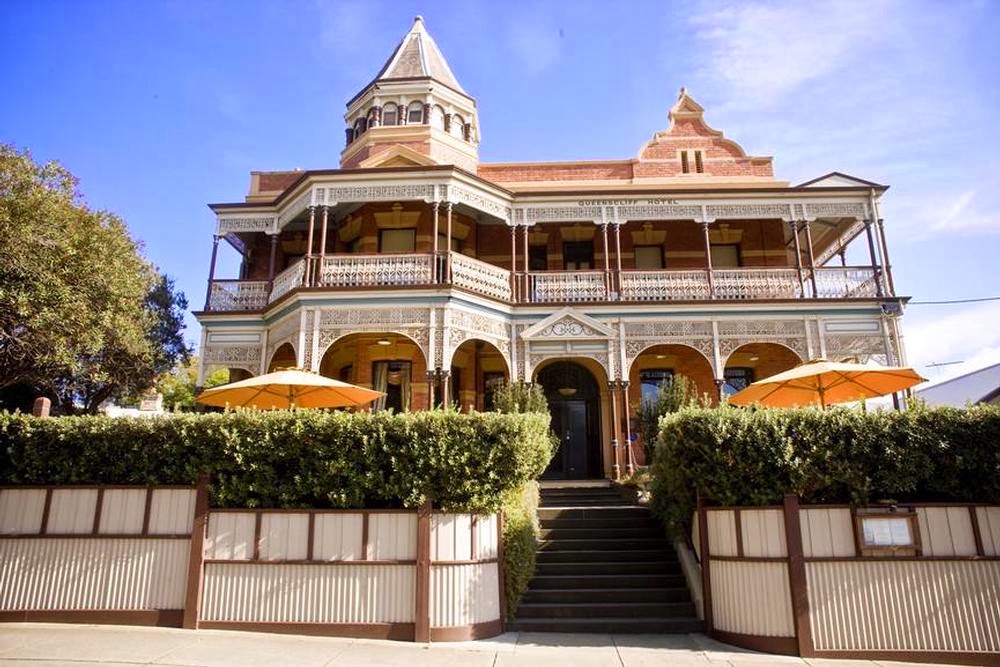
Phyrne's World - The Queenscliff Hotel
In Flying too High after the group have rescued Candida they stay at the Queenscliff Hotel.
The Queencliff Hotel was built in 1887 by Melbourne architects Reed, Henderson and Smart for Martha Nugen and Joseph Goslin. They requested it be built in the style of a house rather than a public building and the design is a reflection of Northern European Renaissance architecture.
In the Victorian era Queenscliff was viewed as a fashionable holiday location to take the sea air.
The Queencliff Hotel was built in 1887 by Melbourne architects Reed, Henderson and Smart for Martha Nugen and Joseph Goslin. They requested it be built in the style of a house rather than a public building and the design is a reflection of Northern European Renaissance architecture.
In the Victorian era Queenscliff was viewed as a fashionable holiday location to take the sea air.
Labels:
Flying too High,
Phryne's World
Phryne's World - The Orient Steamer
Phryne first arrives in Melbourne at the beginning of Cocaine Blues on the Orient steamer.
The Orient was built in 1879 by John Elder & Co, Glasgow and the first ship built for the Orient Steam Navigation Co.Ltd, she was also the first specifically designed for the Australian mail service and built to Admiralty armed merchant cruiser specification. She was a 5,386 gross ton ship, length 460ft (140,21m) x beam 46.3ft (14,12m) x depth 35ft (10,67m) and when registered in September 1879 was the largest ship in the World apart from the 20-year-old, 19,000-ton Great Eastern. She had two funnels, four masts (rigged for sail), iron construction, single screw and a speed of 15 knots. There was passenger accommodation for 120-1st, 130-2nd, 300 steerage class, or 1,500 troops. Launched on 5th June 1879, she sailed from London on her maiden voyage to Melbourne and Sydney via the Cape on 3rd Nov.1879 and returned via Suez. (until 1883 contract voyages went out via the Cape, home via Suez).
She was the biggest ship on the Australian route, and set a London/Adelaide record of 37 days 22 hours. On her second outward voyage in 1880 she set a Plymouth/Cape Town record of 17 days 21 hours which stood for 10 years. In 1881 she had refrigeration fitted and in 1882 was chartered as transport for the Egyptian campaign, then later in 1884 she had electric lights installed. In 1898 the Orient was modernised at Wallsend Slipway and Engineering Co, Wallsend-on-Tyne, rebuilt to 5,453 tons, and fitted with 7,000ihp triple expansion engines to give her a speed of 16½ knots. Her four masts and two funnels had been replaced by two pole masts and a single taller funnel, and a forecastle and turtleback poop had been added. In Nov.1899 she became a troopship for the Boer War and on 17th July 1903 resumed commercial services to Sydney. Her last sailing on this service commenced on 23rd July 1909 and in 1910 she was sold to Italian ship breakers and renamed ORIC for her final voyage to Italy where she was scrapped.
The Orient was built in 1879 by John Elder & Co, Glasgow and the first ship built for the Orient Steam Navigation Co.Ltd, she was also the first specifically designed for the Australian mail service and built to Admiralty armed merchant cruiser specification. She was a 5,386 gross ton ship, length 460ft (140,21m) x beam 46.3ft (14,12m) x depth 35ft (10,67m) and when registered in September 1879 was the largest ship in the World apart from the 20-year-old, 19,000-ton Great Eastern. She had two funnels, four masts (rigged for sail), iron construction, single screw and a speed of 15 knots. There was passenger accommodation for 120-1st, 130-2nd, 300 steerage class, or 1,500 troops. Launched on 5th June 1879, she sailed from London on her maiden voyage to Melbourne and Sydney via the Cape on 3rd Nov.1879 and returned via Suez. (until 1883 contract voyages went out via the Cape, home via Suez).
She was the biggest ship on the Australian route, and set a London/Adelaide record of 37 days 22 hours. On her second outward voyage in 1880 she set a Plymouth/Cape Town record of 17 days 21 hours which stood for 10 years. In 1881 she had refrigeration fitted and in 1882 was chartered as transport for the Egyptian campaign, then later in 1884 she had electric lights installed. In 1898 the Orient was modernised at Wallsend Slipway and Engineering Co, Wallsend-on-Tyne, rebuilt to 5,453 tons, and fitted with 7,000ihp triple expansion engines to give her a speed of 16½ knots. Her four masts and two funnels had been replaced by two pole masts and a single taller funnel, and a forecastle and turtleback poop had been added. In Nov.1899 she became a troopship for the Boer War and on 17th July 1903 resumed commercial services to Sydney. Her last sailing on this service commenced on 23rd July 1909 and in 1910 she was sold to Italian ship breakers and renamed ORIC for her final voyage to Italy where she was scrapped.
Labels:
Cocaine Blues,
Phryne's World
Phryne's World - The Windsor Hotel
When Phryne first moved to Melbourne she stayed at the Windsor Hotel. The Hotel Windsor was built in 1883 by shipping magnate, George Nipper and designed by Charles Webb. It is the only surviving 19th century hotel in Australia.
The hotel was completed in 1884 and named "The Grand". However, Nipper sold the hotel to James Munro who doubled the size of the hotel, completed in 1888. Notable features of the hotel were the Grand Ballroom, the Grand Staircase, the distinctive twin mansard roofed towers in the Second Empire style, and the stone sculpture, attributed to John Simpson Mackennal, over the main entrance with male female figures known as 'Peace and Plenty' reclining over the English and Australian Coat of Arms. Munro was a politician and the leader of the temperance movement in Victoria, who burnt the hotel's liquor licence in public and operated the hotel as a Coffee Palace, now renamed the "Grand Coffee Palace".
Munro was declared bankrupt in February 1893, and a new owner of the hotel took over in 1897. The hotel was amalgamated with the neighbouring Old White Hart Hotel, re-licensed, and its name was changed back to the Grand Hotel. In March 1898, the Constitutional Convention met at the hotel to finalise the final draft of the Constitution of Australia.
In 1920, the hotel changed hands again, was refurbished, and renamed "Windsor Hotel", in honour of the British Royal Family. For much of the 20th century, the hotel dubbed the Duchess of Spring Street was one of the most favoured and luxurious hotels in Melbourne, hosting many notable national and international guests.
With the construction of modern 'international' hotels, starting with the Southern Cross in 1962, the Windsor declined in popularity. In a bid to regain marketshare, the Windsor expanded, purchasing the four storey White Hart Hotel on the Bourke Street corner. The White Hart was demolished and a new classically inspired extension using elements from the old hotel became the Windsor's north wing. Later in the decade a 25 storey residential tower was developed on the opposite side of Little Collins Street, significantly overshadowing the Windsor.
By the mid-1970s, the Windsor was run-down and the last of the major historic 19th century hotels in Australia still operating. The other major hotels, the Menzies (1867–1969) and the Federal (1888–1972) in Melbourne, and the Australia (1890–1971) and Metropole (1890–1969) in Sydney, had all been demolished.
Several proposals were put forward which included the demolition of the Windsor. A 1974 proposal for a 38 storey tower on the corner of Spring and Bourke Street was opposed by the state government and the National Trust. The Rupert Hamer-led state government purchased the building in 1977 to ensure its preservation and in 1980 leased it to The Oberoi Group.
Oberoi undertook a major restoration of the hotel in 1983 costing USD$6.6 million, reinstating the decorative 19th century colour schemes to the lobby, stairhall, and especially the Grand Dining Room, where huge brass chandeliers were reproduced from photographs. This was one of the first major private historic restorations in Melbourne, and won a Victorian Architect's Institute award. Its position as a leading five-star hotel and a major Melbourne landmark was then firmly re-established. The cricketer's bar, afternoon tea in the grand dining room, and the top-hatted doorman all resumed their status as Melbourne institutions. The John Cain II state government sold the hotel to the Oberoi Group giving the company freehold possession in 1990. In 2005, Oberoi sold the hotel to the Halim family based in Indonesia.
The Halim group first proposed to redevelop the Windsor in 2008 shortly after acquiring remaining shares from the Oriental Pacific Group and rebranding as "Hotel Windsor", with a $45 million redevelopment which proposed to modernise many of the interiors although they would not disclose whether the hotel was running at a loss or making a profit. The plan was approved by Heritage Victoria and the government after significant negotiations with the owners which included reducing the heritage impacts of the proposal. However development did not commence due to the Financial crisis of 2007–2010.
In July 2009, the Halim group proposed a new $260 million refurbishment project which would add 152 rooms to the hotel. This would involve demolition of the hotel's 1960s-era North wing, and replacing it with a contemporary building with facilities expected by guests staying in a five star hotel. A thin curtain wall tower designed by Denton Corker Marshall was proposed be built at the rear of Windsor Place. The architects proposed that the fritted wavy glass of the facade was a solution to minimise the visual impact of the tower. The application submitted to Heritage Victoria included restoration of the 1880s facade facing Spring and Little Collins Streets.
The National Trust of Australia (Victoria), opposed to the development responded with a campaign named 'Save the Windsor'. and claimed that the proposed tower was inappropriate and would breach established height controls for the Bourke Hill precinct initially put in place to protect vistas of the Windsor, Parliament House and St Patrick's Cathedral. These controls do not exist south of the Windsor where there are taller buildings, including 99 Spring Street, an apartment building completed in 1971. At 24 floors and 77 metres it is shorter than the proposed tower, yet it fronts onto the heritage precinct of Spring Street and is located directly next to the Windsor.
In late February 2010, a news leak occurred which erupted in a government scandal surrounding the redevelopment of the Windsor Hotel. A document prepared by a senior media advisor to Planning Minister Justin Madden was sent by email to the ABC Newsdesk. It detailed plans by the Victorian Government to run a sham community consultation process in a bid to reject the plans. In response to public outcry, a probity officer was appointed to oversee the decision making process.
On 18 March 2010, the hotel refurbishment and redevelopment plans were approved by then Planning Minister, Justin Madden. This was a major step in the planning permit approval process.
The Senate of Australia has officially recognised the national significance of the Windsor Hotel. The National Trust lost an appeal against the proposed refurbishment and redevelopment when it took the Hotel to the Supreme Court of Victoria.
Heritage Permits were resolved in January 2012 and this delay meant the hotel owners needed to take the 2010 planning permit to VCAT to seek an extension to its expiry date. This was granted in August 2012 and The Windsor's renovations are now expected to begin in late 2014.
Notable guests at the Windsor have included Margaret Thatcher, George VI of the United Kingdom and Elizabeth Bowes-Lyon (as Duke and Duchess of York), Meryl Streep, Anthony Hopkins, Gregory Peck, Laurence Olivier, Vivien Leigh, Katharine Hepburn, Basil Rathbone, Lauren Bacall, Douglas Fairbanks, Byron Sharp, Claudette Colbert, Robert Helpmann, Rudolph Nureyev, Dame Nellie Melba, Dame Joan Sutherland, Dame Margot Fonteyn, Michael Dukakis, Muhammad Ali, Barry Humphries, Don Bradman and the Australia national cricket team as well as Australian prime ministers Sir Robert Menzies, Malcolm Fraser, Bob Hawke, Paul Keating and John Howard.
Information courtesy of Wikipedia
The hotel was completed in 1884 and named "The Grand". However, Nipper sold the hotel to James Munro who doubled the size of the hotel, completed in 1888. Notable features of the hotel were the Grand Ballroom, the Grand Staircase, the distinctive twin mansard roofed towers in the Second Empire style, and the stone sculpture, attributed to John Simpson Mackennal, over the main entrance with male female figures known as 'Peace and Plenty' reclining over the English and Australian Coat of Arms. Munro was a politician and the leader of the temperance movement in Victoria, who burnt the hotel's liquor licence in public and operated the hotel as a Coffee Palace, now renamed the "Grand Coffee Palace".
Munro was declared bankrupt in February 1893, and a new owner of the hotel took over in 1897. The hotel was amalgamated with the neighbouring Old White Hart Hotel, re-licensed, and its name was changed back to the Grand Hotel. In March 1898, the Constitutional Convention met at the hotel to finalise the final draft of the Constitution of Australia.
In 1920, the hotel changed hands again, was refurbished, and renamed "Windsor Hotel", in honour of the British Royal Family. For much of the 20th century, the hotel dubbed the Duchess of Spring Street was one of the most favoured and luxurious hotels in Melbourne, hosting many notable national and international guests.
With the construction of modern 'international' hotels, starting with the Southern Cross in 1962, the Windsor declined in popularity. In a bid to regain marketshare, the Windsor expanded, purchasing the four storey White Hart Hotel on the Bourke Street corner. The White Hart was demolished and a new classically inspired extension using elements from the old hotel became the Windsor's north wing. Later in the decade a 25 storey residential tower was developed on the opposite side of Little Collins Street, significantly overshadowing the Windsor.
By the mid-1970s, the Windsor was run-down and the last of the major historic 19th century hotels in Australia still operating. The other major hotels, the Menzies (1867–1969) and the Federal (1888–1972) in Melbourne, and the Australia (1890–1971) and Metropole (1890–1969) in Sydney, had all been demolished.
Several proposals were put forward which included the demolition of the Windsor. A 1974 proposal for a 38 storey tower on the corner of Spring and Bourke Street was opposed by the state government and the National Trust. The Rupert Hamer-led state government purchased the building in 1977 to ensure its preservation and in 1980 leased it to The Oberoi Group.
Oberoi undertook a major restoration of the hotel in 1983 costing USD$6.6 million, reinstating the decorative 19th century colour schemes to the lobby, stairhall, and especially the Grand Dining Room, where huge brass chandeliers were reproduced from photographs. This was one of the first major private historic restorations in Melbourne, and won a Victorian Architect's Institute award. Its position as a leading five-star hotel and a major Melbourne landmark was then firmly re-established. The cricketer's bar, afternoon tea in the grand dining room, and the top-hatted doorman all resumed their status as Melbourne institutions. The John Cain II state government sold the hotel to the Oberoi Group giving the company freehold possession in 1990. In 2005, Oberoi sold the hotel to the Halim family based in Indonesia.
The Halim group first proposed to redevelop the Windsor in 2008 shortly after acquiring remaining shares from the Oriental Pacific Group and rebranding as "Hotel Windsor", with a $45 million redevelopment which proposed to modernise many of the interiors although they would not disclose whether the hotel was running at a loss or making a profit. The plan was approved by Heritage Victoria and the government after significant negotiations with the owners which included reducing the heritage impacts of the proposal. However development did not commence due to the Financial crisis of 2007–2010.
In July 2009, the Halim group proposed a new $260 million refurbishment project which would add 152 rooms to the hotel. This would involve demolition of the hotel's 1960s-era North wing, and replacing it with a contemporary building with facilities expected by guests staying in a five star hotel. A thin curtain wall tower designed by Denton Corker Marshall was proposed be built at the rear of Windsor Place. The architects proposed that the fritted wavy glass of the facade was a solution to minimise the visual impact of the tower. The application submitted to Heritage Victoria included restoration of the 1880s facade facing Spring and Little Collins Streets.
The National Trust of Australia (Victoria), opposed to the development responded with a campaign named 'Save the Windsor'. and claimed that the proposed tower was inappropriate and would breach established height controls for the Bourke Hill precinct initially put in place to protect vistas of the Windsor, Parliament House and St Patrick's Cathedral. These controls do not exist south of the Windsor where there are taller buildings, including 99 Spring Street, an apartment building completed in 1971. At 24 floors and 77 metres it is shorter than the proposed tower, yet it fronts onto the heritage precinct of Spring Street and is located directly next to the Windsor.
In late February 2010, a news leak occurred which erupted in a government scandal surrounding the redevelopment of the Windsor Hotel. A document prepared by a senior media advisor to Planning Minister Justin Madden was sent by email to the ABC Newsdesk. It detailed plans by the Victorian Government to run a sham community consultation process in a bid to reject the plans. In response to public outcry, a probity officer was appointed to oversee the decision making process.
On 18 March 2010, the hotel refurbishment and redevelopment plans were approved by then Planning Minister, Justin Madden. This was a major step in the planning permit approval process.
The Senate of Australia has officially recognised the national significance of the Windsor Hotel. The National Trust lost an appeal against the proposed refurbishment and redevelopment when it took the Hotel to the Supreme Court of Victoria.
Notable guests at the Windsor have included Margaret Thatcher, George VI of the United Kingdom and Elizabeth Bowes-Lyon (as Duke and Duchess of York), Meryl Streep, Anthony Hopkins, Gregory Peck, Laurence Olivier, Vivien Leigh, Katharine Hepburn, Basil Rathbone, Lauren Bacall, Douglas Fairbanks, Byron Sharp, Claudette Colbert, Robert Helpmann, Rudolph Nureyev, Dame Nellie Melba, Dame Joan Sutherland, Dame Margot Fonteyn, Michael Dukakis, Muhammad Ali, Barry Humphries, Don Bradman and the Australia national cricket team as well as Australian prime ministers Sir Robert Menzies, Malcolm Fraser, Bob Hawke, Paul Keating and John Howard.
Information courtesy of Wikipedia
Labels:
Phryne's World
Locations in Cocaine Blues
The following list is all the locations visited (or mentioned) in Cocaine Blues:
Flagstaff gardens – where butcher george dumped his victim
The Windsor - the hotel Phryne stays at when she gets to Melbourne
Victoria Markets
The Orient - the ships Phyrne travels to Melbourne on
Government House, Melbourne
The Athenauem Club
Royal Archade
The Block Archade
Collins House
The Menzies
Scotts Hotel
Elevator House – Salvation Army
Queen Victoria Hospital - Where Dr Mac works
Rive Gauche, Paris
Collins St – up the hill – Theosophical building – theatre – 2 churches – couturiers -Phrynes journey to her hotel
Presbyterian church – the Manse - baptist church – the regent theatre - Tivoli theatre (where Sasha is performing) - Town Hall eves - Swanson street - Phyrne's walking route
Lonsdale street – queen street – Market street - exhibition street – collins street – mint place - Berts route to take Alice to hospital
Russell Street police station
Swanson Street Cathedral
The Melbourne club – Phryne wants Robert Sanderson MP to take her to dinner there
Pickle factory in Fitzroy – where Dots friend works
Madame Olgas – Collins St
Elizabeth Arden Beauty Parlour – Collins St
Toorook Rd – Paradise St, Soho – Place Pigalle -Phryne's walk home from the Cryer's party
79 Little Lonsdale St - The chemist dealing pink powders
Dynon road heading west – tea gardens - Where Phryne, Dot, Cec and Bert have a picnic
The Melba Gala - (not really a place more an event) The Gala in honor of Dame Nellie Melba
Flagstaff gardens – where butcher george dumped his victim
The Windsor - the hotel Phryne stays at when she gets to Melbourne
Victoria Markets
The Orient - the ships Phyrne travels to Melbourne on
Government House, Melbourne
The Athenauem Club
Royal Archade
The Block Archade
Collins House
The Menzies
Scotts Hotel
Elevator House – Salvation Army
Queen Victoria Hospital - Where Dr Mac works
Rive Gauche, Paris
Collins St – up the hill – Theosophical building – theatre – 2 churches – couturiers -Phrynes journey to her hotel
Presbyterian church – the Manse - baptist church – the regent theatre - Tivoli theatre (where Sasha is performing) - Town Hall eves - Swanson street - Phyrne's walking route
Lonsdale street – queen street – Market street - exhibition street – collins street – mint place - Berts route to take Alice to hospital
Russell Street police station
Swanson Street Cathedral
The Melbourne club – Phryne wants Robert Sanderson MP to take her to dinner there
Pickle factory in Fitzroy – where Dots friend works
Madame Olgas – Collins St
Elizabeth Arden Beauty Parlour – Collins St
Toorook Rd – Paradise St, Soho – Place Pigalle -Phryne's walk home from the Cryer's party
79 Little Lonsdale St - The chemist dealing pink powders
Dynon road heading west – tea gardens - Where Phryne, Dot, Cec and Bert have a picnic
The Melba Gala - (not really a place more an event) The Gala in honor of Dame Nellie Melba
Labels:
Cocaine Blues,
Locations,
Phryne's World
Phryne's World: Miss Fisher's Residence
When Phryne first moves to Melbourne she stays at The Windsor Hotel but having decided to stay on and set up as a Lady Detective she acquires a property at 221B The Esplanade, St Kilda (The B she adds to the address as a homage to Sherlock Holmes who lived at 221B Baker St). The house is described in Flying Too High as
"a neat bijou townhouse, faced with shining white stucco so it looked like an iced cake. It had two storeys and a delightful attic-room with a gable window which Dot had claimed."
The address itself is entirely fictional and in the TV series Wardlow at 114 Park Drive, Parkville is used for the outside shots of the house.
"a neat bijou townhouse, faced with shining white stucco so it looked like an iced cake. It had two storeys and a delightful attic-room with a gable window which Dot had claimed."
The address itself is entirely fictional and in the TV series Wardlow at 114 Park Drive, Parkville is used for the outside shots of the house.
The inside shots of the house are filmed on a sound stage and the rooms are meticulously designed to match the descriptions in the books. Which is explained more in the video below:
Labels:
Phryne's World
Subscribe to:
Posts (Atom)